Unified Demand Intelligence
The Parker Avery Group's retail demand platform, which was Enterprise Intelligence and is now Unified Demand Intelligence
Unified Demand Intelligence is a demand platform for retailers, made by The Parker Avery Group, a retail consulting and AI firm based in Atlanta, Georgia. I joined in 2022, and it's the product I've worked on since. It began as a product for the company's own use and grew into one it sells to its clients.
In plain terms, a retail company uses it to see how each part of the business is selling, how that compares with what was projected, and what the next sales are predicted to be. Predicting sales with AI is one of the firm's services, of course. The platform is where those numbers land in front of the people who have to act on them.
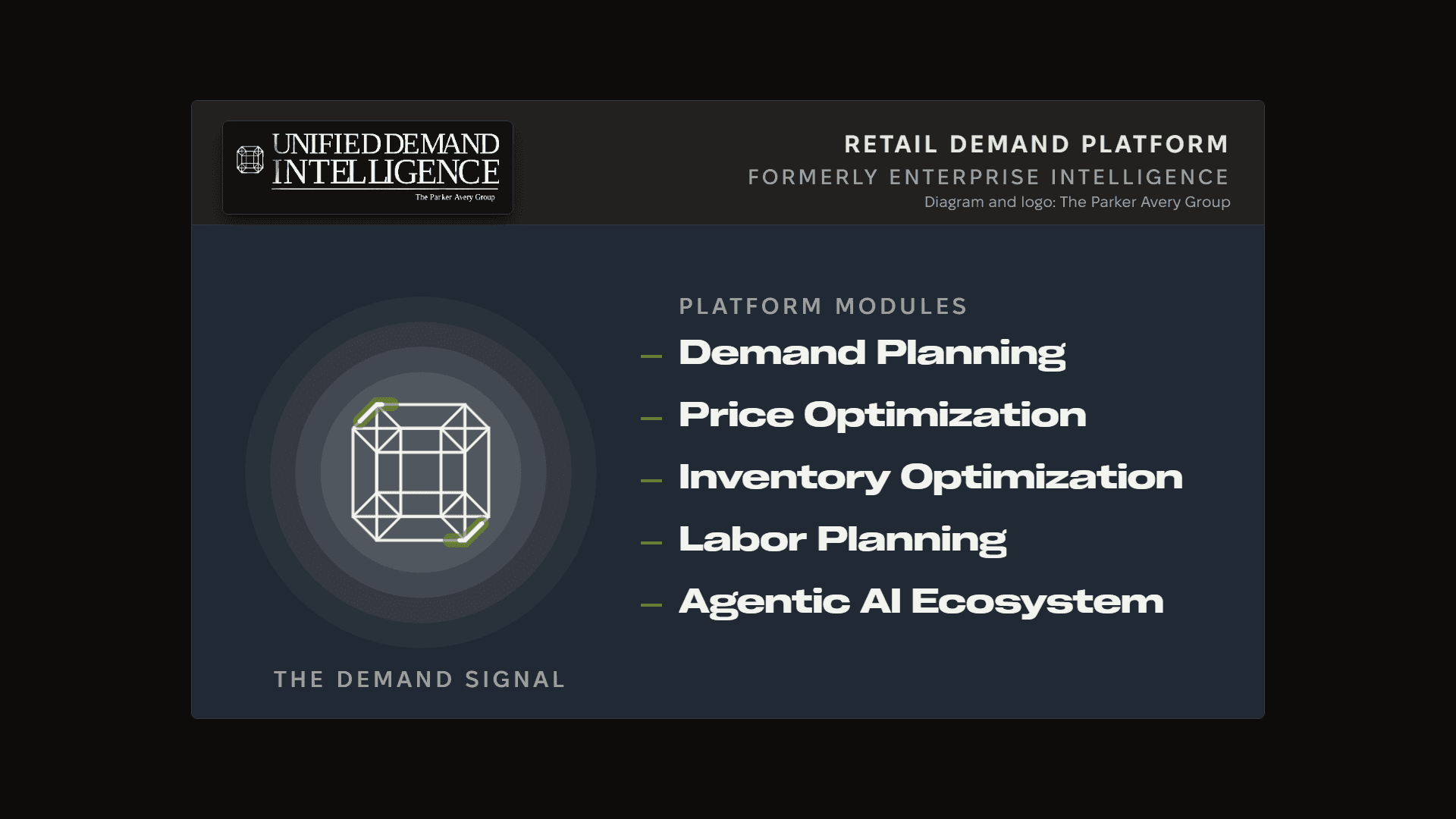
In total, here's 5 modules: Demand Planning, Price Optimization, Inventory Optimization, Labor Planning and an Agentic AI Ecosystem. All of them read off one shared demand signal, so pricing, inventory and planning are working from the same forecast. Back in 2023, when the platform was still called Enterprise Intelligence, the piece underneath that already had its own name, the Hypercube. It slices product, geography and channel hierarchies dynamically around that one signal.
Ask Udi is the headline feature of the current generation, the assistant inside the platform. Anyone on the team can put a question to the retail data in everyday language, and the answer comes back ready to use: a table, a chart or a report, as deep as the question goes. Nobody writes a query, and nobody waits for an analyst to get back to them. The longer jobs, a "big data analysis run" for example, go to the background. The interface shows the work is running and doesn't tie up the screen, and the report shows up when it's done. If you want a different view of the same results, you just ask again, and the whole run doesn't start over.
Then there's the data itself. The model never gets its hands on the whole dataset, the raw rows don't leave the server, and the person asking still gets every one of them in the table or chart. It's a pretty uncommon way to build an assistant like this, and how it works under the hood is in the entry for The Parker Avery Group.
I'm a Senior Developer at The Parker Avery Group. The platform was running more than a year before I joined, and my first months went into foundations work under it. My main piece is the natural-language assistant, which I started on in 2024 and built together with other engineers. I also wrote the layer that joins the assistant to the main operator application: streaming to several browser windows at once, and the chat, the dataset table, the chart and the report components people actually click on.
Around that, there's about 4 years of continuous work across the platform's services and its delivery side. On the delivery side that means end-to-end tests and delivery to every environment. On the services side it's the shared backend, such as the common helper library, configuration, identity, authorization, and the user, role and group management services.
Unified Demand Intelligence, Ask Udi, the published modules and the published figures are the work of The Parker Avery Group.
Stack
- TypeScript
- Node.js
- Fastify
- GraphQL
- Kubernetes
Credits
- The Parker Avery Group
- Demand-signal diagram, vector form
- Current-era social card, the product page og:image
- Reversed white Enterprise Intelligence product logo
- 2021 Home Screen product image
- 2021 Demand Plan product image
- 2022 Demand Plan product image
- 2022 retail-planning product images
- The Parker Avery Group
- Published product demo video, Enterprise Intelligence era
- Enterprise Intelligence dashboard screen
- Enterprise Intelligence task-list screen
- Enterprise Intelligence demand-plan screen